Aging is not simply a personal struggle. It is a global emergency that quietly affects every family, every healthcare system, and every economy on Earth. It takes over one hundred thousand lives every single day through slow biological decline that most people accept as inevitable. The tragedy is that aging is rarely treated as the core cause of suffering. Instead, we treat its symptoms one by one. Cancer. Dementia. Stroke. Organ failure. We fight each battle separately and ignore the fact that they often come from the same source. Artificial intelligence may allow us to face aging differently, not as fate but as a system of failures that can be mapped, understood, and treated.
Biology is complex in a way that human reasoning struggles to process. Genetic pathways, protein folding, cellular signals, and molecular interactions overlap in ways that no person can fully track. AI does not feel overwhelmed by complexity. It can hold patterns, detect relationships, and process biological data at a speed that transforms how research can happen. For the first time, humanity may have a way to pull all the scattered knowledge about aging into something coherent. If we do this correctly, aging may shift from a concept beyond human control to an engineering challenge that can be overcome through insight and persistence.
Why Aging Should Be Seen as a Crisis
Most people do not think of aging as a crisis because it unfolds gradually. That is what makes it difficult to confront. A disaster that happens slowly often feels “natural” even when it is causing tremendous harm. Yet aging brings more death and illness every day than any war or natural disaster. It drains families of savings and time. It consumes healthcare budgets. It reduces the creative and productive years of life. If this harm came from any other source, it would be declared a global emergency.
The idea that aging is inevitable has been reinforced for centuries through culture and tradition. Many people view it as a path to wisdom. Wisdom, however, does not depend on cellular decline. A clear mind may operate best when the body is strong. If longer healthspans are possible, it may be time to reconsider the assumption that aging is a noble decline. Humanity may gain more by treating aging as something to repair rather than something to accept.
Where AI Can Help Most
Researchers already understand that aging is linked to damage accumulation across multiple systems. Cells stop dividing properly. Proteins misfold. Senescent cells appear and refuse to die. Stem cells lose their ability to repair tissue. None of these failures act alone. They form complex relationships that are difficult to study with traditional tools. AI does not see complexity as a barrier. It can examine thousands of variables at once and look for patterns too subtle for the human eye.
Here are some realistic tasks AI could help with in the fight to end aging:
- Identify early warning signs of decline before symptoms appear
- Speed up drug discovery by reducing time spent on trial and error
- Model biological systems at the cellular and tissue levels
- Simulate clinical trials virtually before real trials begin
- Personalize treatments based on biological profiles
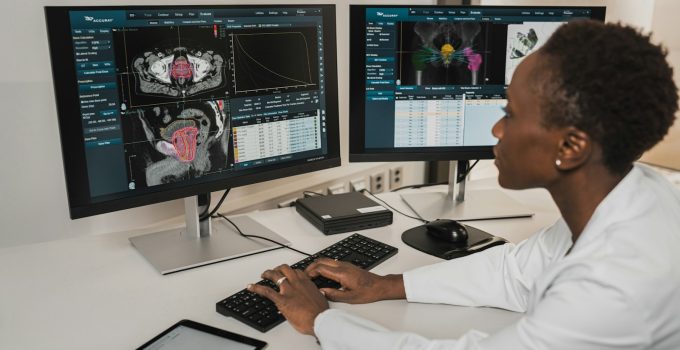
AI can analyze data from genetics, blood tests, imaging scans, and biomarkers to create individual health maps. These maps may one day allow doctors to predict which systems are weakening long before illness arrives. That would make prevention possible. It would also shift medicine from reactive care to proactive repair.
The Barrier of Fragmented Research
One of the greatest challenges in aging research is fragmentation. Each part of aging is studied under different medical categories. A cardiologist treats heart failure. A neurologist studies dementia. An oncologist studies cancer. Yet all of these diseases increase in likelihood as aging progresses. This suggests that aging is not only a medical topic. It is a foundational biological process that influences nearly every system of the body.
AI can integrate these separate fields. It can cross reference patterns that specialists rarely see together. A machine can notice that a certain inflammation marker relates to changes in the brain or that protein folding issues relate to organ failure. This kind of integration is necessary if humanity wants to address aging at its roots instead of waiting for symptoms to appear. When data across disciplines becomes unified, new strategies emerge that were invisible before.
Another difficulty is language itself. Traditional medical language treats aging as an unavoidable decline. But if we change the vocabulary and label aging as a repairable process, then policy begins to shift. Funding begins to shift. Expectations begin to shift. Progress often follows the language that researchers and governments adopt. AI can help by bringing evidence that aging is measurable, reversible in some cases, and scientifically targetable.
A Practical Roadmap for AI Guided Longevity Research
If humanity treats aging as an engineering challenge, then the process must be systematic. The most likely approach would begin with measuring health at the molecular level. Real time tracking of cell damage would allow researchers to target the precise steps where failure begins. Once failure is mapped, AI could test possible interventions across large simulated models before researchers ever enter a lab.
A staged roadmap might look like this:
- Build biological models that show how aging unfolds step by step.
- Identify biomarkers that predict decline early in life.
- Use AI to speed up discovery of molecules and compounds that repair damage.
- Test the most promising treatments virtually to reduce cost and risk.
- Personalize interventions based on individual genetic and metabolic patterns.
None of this removes the human element. Researchers still design experiments. Doctors still evaluate patient needs. But AI becomes the compass that guides attention. It reduces guesswork and refines strategy. The real power lies in allowing AI to search across data too large for any mind to hold in place. With that capability, aging no longer appears as a chaotic mystery. It begins to appear as a set of problems that might be solved.
Addressing Concerns About Longer Life
Whenever the idea of slowing aging arises, people raise concerns about overpopulation or resource strain. Yet aging already exerts massive pressure on global resources. Endless medical treatment, late stage care, and rapid decline cost societies trillions of dollars every year. If people stayed healthy for longer, those resources could shift toward innovation, education, and creative work.
There is also a moral question. If aging causes suffering and if a method to reduce that suffering becomes available, then not using that method becomes ethically troubling. Some argue that longer lives might reduce meaning, but history suggests the opposite. When health improves, exploration grows. Knowledge grows. Cultural development grows. Aging has always limited how much the human mind can explore. If that barrier is reduced, human potential may expand rather than shrink.
This shift would also change how people imagine life. Education may not need to stop in youth. A person could begin a new career at 60 or 70 and still have energy and clarity. Families could have more years together in full health. Wisdom would not vanish with strength. The mind and the body might age together with dignity.
Cultural Change Must Accompany Scientific Progress
AI alone will not defeat aging. Society must rethink how it values health and longevity. If treatments are only available to wealthy individuals, then aging may become a line that separates privilege from suffering. That outcome must be prevented. If AI helps lower the cost of discovery, treatments may become broadly affordable. Governments and institutions must be ready to support public access.
Education will also matter. The public must understand aging as something measurable and technically solvable. That will shift political and financial priorities. When aging is considered medical rather than poetic, research funding will increase and institutions will adapt their goals. If this is done with care, longevity science could become as standard as dentistry or vaccination.
Policy will play a major role. Ethical guidelines will be required. There must be clarity about testing methods, access to treatment, and global standards. Yet the shift will likely begin with simple acceptance that aging is not beyond human understanding. Once that belief is widely held, technological progress will accelerate.
Closing Thoughts on a Turning Point
Humanity has always advanced when it learned to measure the invisible. Microscopes revealed bacteria. Satellites revealed weather patterns. Gene sequencing revealed heredity. AI may allow humanity to see aging itself as a layered process that can be interrupted. That would place humanity at a turning point as significant as the discovery of antibiotics.
Ending aging does not mean chasing immortality. It means preserving capability and vitality far longer than today. It means directing societal energy toward creation rather than decline. It means refusing to accept mass suffering when tools exist that may reduce it. The work will take time and caution, but science is shaped by will. If we decide that aging is a crisis worth solving, artificial intelligence will help illuminate a path toward that solution.
This is a moment where technology and ethics meet. If aging truly is humanitys greatest crisis and AI is an instrument capable of helping us resolve it, then the question becomes straightforward. Are we willing to challenge what was once seen as inevitable. If we are, then the fight against aging may be the greatest humanitarian effort of this century.