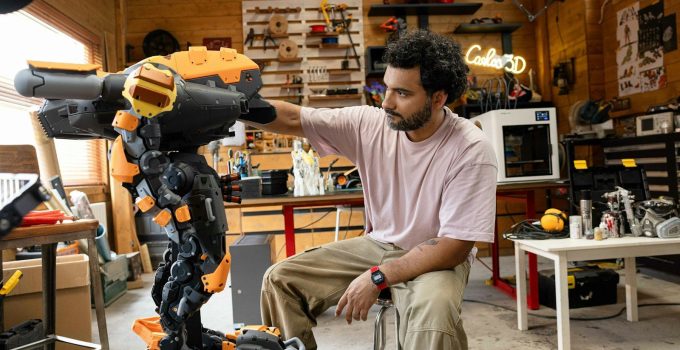
Artificial intelligence is steadily moving beyond the role of a passive tool. Increasingly, systems are being designed to make decisions, take actions, schedule tasks, write code, generate media, manage logistics, and even interact with other systems without direct human involvement. This transition toward agentic systems represents more than a technological shift. It represents a philosophical shift in how humans relate to action, responsibility, and autonomy itself.
For many people, automation feels convenient. It removes friction, reduces repetition, and saves time. Yet there is another side to this transition that deserves more attention. As systems become more capable of acting on behalf of humans, there is a growing risk that humans slowly surrender not only labor, but also intentionality. Convenience can quietly evolve into passivity. Assistance can slowly become dependency.
The question is no longer whether AI systems will become more autonomous. That trend is already underway. The more important question is whether humans will remain psychologically and philosophically autonomous as those systems expand.
The Difference Between Assistance And Surrender
Technology has always extended human capability. Calculators extend arithmetic. Search engines extend memory retrieval. Vehicles extend movement. AI extends cognition itself. There is nothing inherently negative about this. Human civilization has advanced through tools that amplify human capacity.
The problem emerges when amplification turns into replacement in areas that shape identity and agency. A calendar application that helps organize time is useful. A system that silently dictates priorities, restructures behavior, filters communication, and optimizes daily life according to opaque metrics begins to cross into a different category entirely.
Many people assume autonomy disappears suddenly, through obvious force or coercion. In reality, autonomy is often surrendered gradually. Small decisions are outsourced because doing so feels easier. Over time, the habit of intentional action weakens. The individual remains physically free while psychologically becoming more passive.
This creates a paradox. The more advanced systems become, the more important human intentionality becomes. Yet intentionality is precisely the thing many automated systems unintentionally erode.
The Seduction Of Optimization
Modern systems increasingly revolve around optimization. Algorithms optimize feeds, schedules, advertisements, logistics, navigation routes, and entertainment recommendations. AI systems promise even deeper optimization by adapting dynamically to user behavior.
Optimization sounds inherently beneficial, but optimization always depends on selected metrics. A system optimized for engagement may amplify outrage. A system optimized for productivity may slowly eliminate reflection, spontaneity, or exploration. A system optimized for convenience may reduce opportunities for skill development and independent thought.
Human beings are not machines pursuing a single objective function. Human flourishing often involves contradiction, inefficiency, experimentation, uncertainty, and emotional complexity. Some of the most meaningful experiences in life emerge from situations that would appear irrational to a purely optimizing system.
This tension matters because agentic systems increasingly shape the environments people inhabit. Recommendation systems influence perception. Automated workflows influence behavior. AI-generated media influences interpretation. Over time, these influences accumulate into something larger than isolated conveniences. They become invisible architectures shaping daily life.
The Importance Of Friction
Many modern systems are designed around friction reduction. The goal is to minimize effort and maximize speed. In certain contexts, this is valuable. Reducing unnecessary complexity can improve quality of life and free humans for higher level pursuits.
However, not all friction is harmful. Some forms of friction create awareness. Reflection often requires pause. Learning requires difficulty. Skill development requires repetition. Moral reasoning frequently emerges from wrestling with uncertainty rather than instantly receiving optimized answers.
If every form of resistance is removed from human experience, people may become increasingly disconnected from the processes that shape understanding and judgment. The result is not necessarily oppression in a dramatic sense. It is something quieter. A gradual weakening of active participation in one’s own life.
This is one reason why preserving spaces for intentional effort matters. Humans often derive meaning not only from outcomes, but from participation itself. The process of struggling, deciding, adapting, and learning shapes identity in ways that passive consumption does not.
Remaining The Pilot Of One’s Own Life
As agentic systems expand, maintaining autonomy may increasingly require conscious practice. This does not mean rejecting technology. It means relating to technology deliberately rather than passively.
A person can use AI systems while still preserving agency. The distinction depends on whether the human remains the primary source of direction and judgment. A navigation system may suggest routes, but the human still determines the destination. A writing assistant may generate ideas, but the human still shapes meaning and values.
Problems emerge when humans stop exercising those deeper forms of judgment. If systems begin determining goals rather than merely assisting with execution, autonomy becomes diluted. The individual may still feel free while increasingly operating within invisible constraints created by algorithms and automated structures.
This is why philosophical clarity matters. Humans must distinguish between tools that expand agency and systems that gradually absorb it. The line is not always obvious because many systems provide genuine benefits while simultaneously encouraging passivity.
The Rise Of Algorithmic Culture
Culture itself is increasingly shaped by algorithmic systems. Music discovery, news exposure, entertainment trends, and even political narratives are filtered through recommendation engines. AI systems may intensify this process further by generating personalized media environments tailored to individual psychology.
This creates a situation where perception itself becomes increasingly mediated. People may begin inhabiting highly individualized informational realities shaped by systems optimized for retention and engagement. Over time, this can weaken independent exploration and reduce encounters with unexpected perspectives.
Autonomy requires more than the ability to make choices. It also requires access to diverse information, reflective distance, and the ability to step outside optimized systems long enough to evaluate them critically.
Without this reflective space, individuals risk becoming reactive rather than intentional. They respond continuously to stimuli generated by systems designed to shape behavior. The human mind becomes increasingly navigated rather than navigating.
The Ethical Responsibility Of Builders
The responsibility for preserving autonomy does not rest solely on individuals. Designers, developers, and institutions also shape the ethical direction of technological systems.
Builders increasingly influence not only what systems can do, but how humans relate to themselves and one another through those systems. Design choices affect attention, behavior, emotional states, and social interaction patterns. These effects are not secondary consequences. They are central consequences.
This raises important ethical questions. Should systems always optimize for engagement? Should convenience always override intentional participation? Should AI systems encourage dependency if dependency increases retention metrics?
The future of automation will not be shaped only by technological capability. It will also be shaped by values embedded within systems. Questions about autonomy, dignity, and human agency may ultimately become more important than questions about raw computational power.
The Future May Depend On Human Intentionality
There is a common fear that AI systems may eventually overpower humanity through force or dominance. A more immediate concern may be quieter and more subtle. Humans may gradually surrender intentionality voluntarily because convenience feels easier than active participation.
This does not require dystopian scenarios. It can emerge through ordinary habits. Delegating more decisions. Spending less time reflecting. Accepting algorithmic suggestions automatically. Allowing systems to shape priorities without examination.
The challenge of the coming decades may not simply involve controlling machines. It may involve preserving the human capacity for conscious direction in a world increasingly optimized for passive flow.
Technology can absolutely expand human freedom and capability. AI systems may help humanity solve enormous problems, accelerate discovery, reduce scarcity, and improve quality of life. However, these benefits become most meaningful when humans remain active participants in shaping the future rather than passive recipients of automated optimization.
The central question is not whether machines will become more capable. The central question is whether humans will remain deeply connected to judgment, reflection, responsibility, and intentional action as those machines evolve.
That may ultimately determine whether automation strengthens human autonomy or slowly dissolves it.