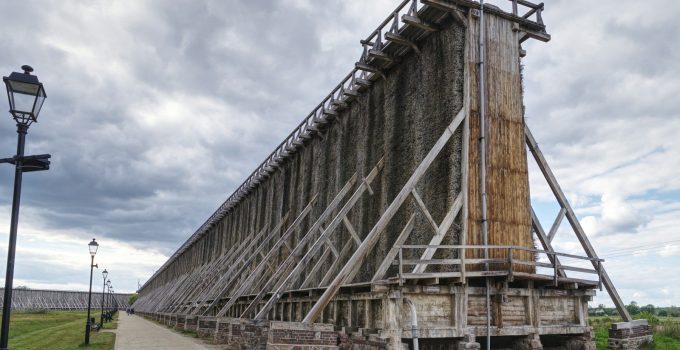
On a still afternoon in Ciechocinek, in the Polish lowlands, a timber wall taller than a house curves through the park in a long horseshoe. Brine, pumped to the top, slips down through bundles of blackthorn twigs and breaks into drops. The air close by is cooler than the path, faintly wet, and carries a mineral smell that visitors often compare to the seaside, even though the Baltic is far away. People walk the circuit slowly or sit on benches while white crust glints on the twigs. This is a brine graduation tower, or tężnia solankowa in Polish and Gradierwerk in German.
A first look can be misleading. The structure is not always a cylinder, and it is not a salt room. Some towers stand as long open walls, some form rings or polygons, and some sit under a light roof. For centuries these frames existed to make salt. The mist that now draws walkers began as a byproduct of that work.
From Salt Works to Spa Parks
The word “graduation” here is industrial. It names a method for raising the grade, or concentration, of a weak brine before the liquid was boiled down to crystal salt, saving fuel in the boiling house. Spreading brine for faster evaporation was tried in northern Italy around 1400. North of the Alps, a salt works of this kind was built at Bad Kissingen in 1563, first with straw. Around 1700, blackthorn replaced straw, partly because it left a cleaner brine. The tall timber tower familiar today is often credited to Joachim Friedrich von Beust, who promoted works at Bad Salzungen in 1740 and Bad Salzuflen in 1767.
The method spread across the German lands and into Poland, Austria, Switzerland, and France. The Prussian saline at Salzelmen, near Schönebeck, once ran a tower about 1,837 meters long. Cheaper salt from other methods later made most of these plants uneconomic, and many towers were torn down. The survivors, and the new ones built in their image, belong mainly to parks and spas.
Ciechocinek still does both jobs. Construction of its first two towers began in 1824, to a design by Jakub Graff, a professor at the Mining Academy in Kielce. Those walls, 648 and 719 meters long, were finished by 1828, and a third of 333 meters followed in 1859. Together they form a horseshoe about 1,741.5 meters long and 15.8 meters high, resting on about 7,000 oak piles, widely described as the largest wooden graduation complex in Europe. Brine from a source known as the Grzybek, or little mushroom, fountain, still reaches the top at about 5.8 percent. The spa is conventionally dated to 1836, when brine baths became a regular local offering. In 2025 Poland placed the historic saltworks on its UNESCO World Heritage tentative list, noting that salt is still produced there by graduation and pan boiling.
What Happens on the Twigs
A wooden frame is packed with fascines of blackthorn, Prunus spinosa, the thorny shrub of European hedges. Brine flows from troughs at the top and trickles down. Each drop exposes a large surface to sun and wind, water leaves as vapor, and the solution strengthens. Working plants may cycle the brine several times, until it reaches about 25 percent and can finish in the pans. The brushwood is replaced from time to time, because a hard crust called Dornstein, or thornstone, slowly coats the twigs. Research on the Bad Kösen tower, published in 2015 in Salt Review by Hans-Joachim Engelhardt and Lieselotte von Borstel, found this crust is often rich in gypsum. Much of the white buildup, in other words, is not table salt.
Dripping and wind also throw a fine spray into the air. That spray is a wet aerosol, tiny droplets of brine, not a dry powder and not a cloud of loose ionized minerals. The droplets are mostly sodium chloride solution, and depending on the source they can carry small amounts of iodine, bromine, magnesium, calcium, and other ions. A 2022 study in Atmosphere, measuring air at the tower beside the Wieliczka Salt Mine, found that sodium and chloride dominated the particles and that iodide and bromide were enriched compared with air farther away. The authors compared the mix to coastal aerosol. Sunny days with a moderate breeze produce the most mist, while rain or a strong wind changes it.
A Mist of Brine, Not a Chamber of Ions
Graduation towers and salt rooms are cousins rather than twins. A modern halotherapy room is an indoor space, often fed with dry, milled salt by a machine called a halogenerator. A graduation tower works outdoors with a wet mist whose strength rises and falls with sun, wind, and distance from the wall. Speleotherapy, a third practice, takes people into underground salt chambers, as at Wieliczka. All three offer salty air, but not the same air.
Spa towns have long treated the mist as open-air inhalation, and brochures often mention respiratory complaints, tiredness, and high blood pressure. The microclimate is measurable: air near an active tower is usually cooler, more humid, and chemically unlike a city street. The clinical evidence is thinner, and careful studies that separate the mist from rest, holiday mood, and a pleasant park remain limited. Negative ions deserve the most caution. Falling water can generate air ions, and tourism copy invokes them often, yet a 2013 review in the Journal of Negative Results in BioMedicine found no clear support for a respiratory benefit from negative ions. Some operators also ask people with certain thyroid conditions, or a sensitivity to iodine or bromine, to check with a physician before frequent visits.
Poland Built the Largest, Germany Built the First
Poland did not invent the graduation tower, but it holds the most famous surviving complex and has built more new ones than any other country. Konstancin-Jeziorna, just south of Warsaw, struck brine in 1965 and opened the first section of its tower on 21 August 1978, completing the ring by 1980. The circle is 6 meters high and 140 meters around, fed by brine of about 7.5 percent from a borehole roughly 1,750 meters deep. Inowrocław opened a tower in Solanki Park in 2001: two joined polygons, 9 meters high and 300 meters long, with an observation deck. Wieliczka added one beside its salt mine in 2014.
Germany remains the historical heartland, and many towns whose names begin with “Bad” keep a Gradierwerk as a landmark. Bad Kösen’s tower, built in 1779 and 1780, is about 320 meters long and 18 to 20 meters high, preserved with its waterwheel and pumping gear. Bad Dürrenberg has the largest remaining contiguous German facility, about 636 meters today, down from a system that once approached 1,821 meters. Bad Rothenfelde keeps two walls, one of 112 meters built from 1774 to 1777 and one of 412 meters built from 1818 to 1824. Bad Salzuflen, Bad Nauheim, and Bad Kreuznach have them too.
Beyond those two countries, the list is shorter. Austria has several, including a 1956 open-air work at Altaussee fed from the local salt mountain and a 2005 installation in Hall in Tirol. Lithuania has one, the Druskupis tower in Birštonas, opened in 2015. Czech sources state that graduation towers are not found in Czechia, despite its spa tradition, and historic examples in Slovakia or Ukraine are hard to confirm. France once used graduation buildings as well; the long evaporating hall at the royal saltworks of Arc-et-Senans was lost in the early twentieth century.
New Walls in Ordinary Parks
Once spas showed that a tower could serve recreation instead of a boiling house, Polish towns began adding smaller ones to parks, promenades, and housing estates. A 2020 paper in Prace Geograficzne counted 89 publicly accessible outdoor towers in Poland by the end of 2019, with a surge in 2017, 2018, and 2019, many funded from local or participatory budgets during years of concern about smog. Construction has continued since then, including in Kraków. Some new towers are open walls, others partly enclosed or glassed in, which explains why descriptions of the type vary so much.
A visit is mostly walking and sitting. In the old spa towns the towers stand among flower beds, bandstands, and sanatoriums, and the pace is unhurried: a slow circuit, a bench, and the low talk of people who have come for the air. Practical points worth knowing:
- Season: most towers run from spring to autumn; rain and hard frost shut many down.
- Weather: dry days with a light breeze give the fullest mist.
- Etiquette: sites commonly ban smoking, loud music, bicycles, and pets.
- Tickets: some historic parks, including Ciechocinek and Konstancin, charge a small seasonal fee.
- Clothing: the air by the wall feels damp and cool even in July.
The graduation tower began as a machine for making salt with less firewood. It survives as a park structure that turns local brine into a visible crust and an invisible mist, closer to sea air than to a sealed salt chamber. How much that mist does for the body remains a thinner story than the engineering and history, which are solid. This is general information about the towers and the air around them rather than medical advice, and anyone whose health might be affected by iodine or salty, humid air can ask a physician before turning a walk into a routine. Either way, the wall keeps dripping and the twigs keep turning white.